


 English
 Hrvatski
 Slovenščina
Istrian Kažun – A Symbol of Istria Transformed into Wallpaper Design
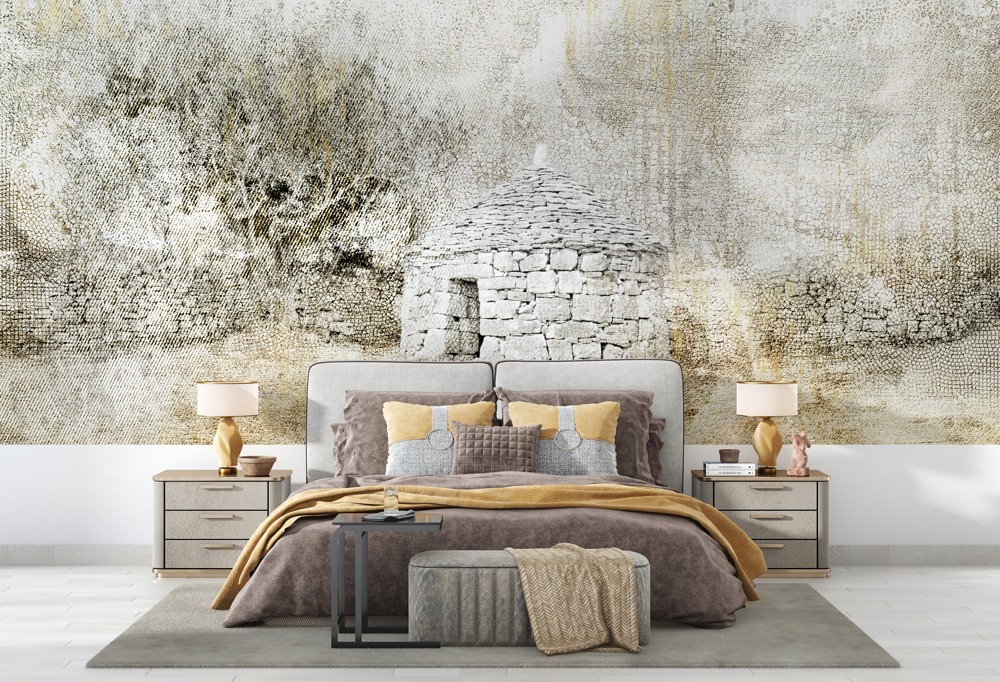
Stone walls, olive trees, vineyards, red soil and a small stone shelter with its distinctive conical roof. Few structures are as simple yet as strongly associated with the Istrian landscape as the kažun.
At first glance modest and simple, the kažun holds within its stone walls centuries of tradition and stories of the people who lived and worked on the Istrian land. Today, it is one of the most recognisable symbols of Istria, and its simplicity, authenticity and connection with the Mediterranean landscape inspired our Istrian Kažun decorative wallpaper.
This design also has a special meaning for us. We introduced it in early 2022, when Tvoja Tapeta became the first brand on the Croatian market to launch a collection of wallpapers inspired by Croatian motifs.
What Exactly Is a Kažun?
A kažun is a traditional Istrian stone shelter, usually circular in shape and characterised by its distinctive conical roof.
It is built using the dry-stone technique – carefully placing stones on top of one another without mortar or any other binding material.
The stone used for construction did not need to be transported from distant locations. It came directly from the land that needed to be cultivated. Istria's characteristic red soil contains large quantities of stone, which farmers had to remove when preparing land for olive groves, vineyards and fields.
Instead of discarding it, they used it.
The stones removed from the soil were used to build kilometres of dry-stone walls marking the boundaries of fields, as well as kažuni that gradually became an inseparable part of the Istrian landscape.
A Shelter for Istrian Farmers and Shepherds
The kažun was not created as decoration.
It was a simple and highly practical structure intended for people who spent their days working far from their homes.
It provided farmers and shepherds with shade during hot summer days and shelter from sudden rain and bad weather. Inside, they could rest, eat a meal, store their tools and sometimes even spend the night if work in a distant field was not finished.
Kažuni were also used as shelters for livestock, particularly sheep.
For generations, this simple stone structure was closely connected with the everyday lives of the people who cultivated the Istrian land.
Built Without Mortar or an Architect
One of the most fascinating characteristics of the kažun is its remarkably simple construction.
Stones are carefully stacked without any binding material, while the roof is formed by gradually moving stone slabs inward until they create the characteristic shape of a corbelled dome.
There were no modern architectural plans or construction machinery. The knowledge of how to build a kažun was passed down from generation to generation.
For this reason, the kažun is often described as an example of architecture without architects – a structure created through experience, locally available materials and the human need to adapt to the surrounding landscape.
Similar stone structures can be found in other parts of the Croatian coast and throughout the Mediterranean under different names, but over time the kažun has become a particularly powerful symbol of Istria.
More Than 3,000 Kažuni Around Vodnjan
The largest concentration of kažuni can be found in southern Istria, particularly in the area around Vodnjan.
There are more than 3,000 kažuni in the Vodnjan area alone, making these small stone structures almost inseparable from the identity of the region.
Although similar structures have existed throughout the Mediterranean since ancient times, the 18th and 19th centuriesare considered the golden age of kažun construction in Istria.
Population growth created a greater need for new fields, vineyards, olive groves and grazing areas. Clearing new land produced large quantities of stone, which was then used to build new dry-stone walls and kažuni.
Kažun Park – Preserving Istrian Tradition
As lifestyles changed and modern agriculture developed, kažuni gradually lost their original function.
Their value, however, did not disappear.
Today, they are recognised as an important part of Istria's architectural and cultural heritage and as a reminder of the way of life of generations that shaped the landscape we know today.
Near Vodnjan, visitors can also discover Kažun Park, an open-air museum where the traditional method of building a kažun is presented through different stages – from the foundations and walls to the characteristic stone roof.
In this way, a skill that was once passed down from generation to generation is being preserved and introduced to new generations.
From an Istrian Symbol to Wallpaper – Our Story Began in 2022
At the beginning of 2022, we at Tvoja Tapeta decided to create something we had not previously seen on the Croatian wallpaper market.
Rather than focusing solely on classic decorative designs and international trends, we looked for inspiration closer to home – in Croatia's architecture, landscapes, cities, history, art and cultural heritage.
This is how Tvoja Tapeta became the first brand on the Croatian market to launch a collection of wallpapers inspired by Croatian motifs, with Istrian Kažun, introduced in early 2022, among the designs that started this story.
The idea was never simply to place an image of a recognisable Croatian landmark on a wall. We wanted to create designs that carried a distinctive story while remaining contemporary enough to become part of a modern interior.
Istrian Kažun was the perfect motif with which to begin.
Its simple geometry, rough stone texture and strong connection with the Mediterranean landscape allowed us to transform a traditional Croatian motif into a decorative element for contemporary spaces.
Following Istrian Kažun, we continued to expand our collection of Croatian motifs with new designs inspired by Croatian cities, landscapes, history, art and cultural heritage.
What began as an idea in early 2022 has since become a recognisable part of the Tvoja Tapeta collection and brand identity.
Istrian Kažun as Inspiration for Contemporary Interiors
Using a traditional motif such as the kažun does not mean that an interior has to be traditional or rustic.
Quite the opposite – combining a traditional motif with contemporary interior design can create a particularly striking contrast.
The natural tones of stone and the Mediterranean landscape work beautifully with wood, natural stone, warm neutral colours, simple furniture and modern architecture.
The Istrian Kažun wallpaper can become an impressive feature wall in a living room, dining room or holiday home, while it can be especially effective in apartments, villas, hotels, traditional restaurants and other hospitality spaces that want to retain a connection with Istria and the Mediterranean.
A Piece of Istria on Your Wall
The kažun is much more than a small stone shelter.
It tells a story of the land from which its stones were taken, the people who cultivated that land and the knowledge passed down from generation to generation for centuries.
For Tvoja Tapeta, it has another special meaning.
Istrian Kažun is one of the designs with which, in early 2022, we became the first on the Croatian market to begin our story of wallpapers inspired by Croatian motifs.
More than four years later, this idea remains an important part of our design identity – interpreting Croatian heritage, art and recognisable motifs in a way that allows them to become part of contemporary interiors.
Discover the Istrian Kažun decorative wallpaper in the Tvoja Tapeta collection.
In Same Category
- Apoxyomenos – A Story from the Depths of the Adriatic Transformed into Wallpaper Design
- When a Wall Becomes Part of the Brand: A Case Study in Personalized Office Design
- From a Child’s Room to a Birthday Celebration: How to Create a World Made Just for Them
- Why Choose Self-Adhesive Wallpaper? The Difference You’ll Notice During Installation
- How to Measure a Wall for a Wallpaper Mural: A Simple 5-Step Guide